
New Partnership—Faster, Better, Less Effort
Flashcards secure complete agreements: Red-Green flags what must move from System-2 understanding to System-1 reflex.
🔵 This post is part of my Red-Green in the Bidding series, where I show how system flashcards strengthen partnership agreements.
What this is about
Two good players become a good partnership by doing three steps—in order.
Step 1 — Fill out the convention card together.
This gives you shared headlines and the section-by-section index.
Step 2 — Reach full agreement on everything the card doesn’t hold.
These are the details and the many treatments, conventions, and methods with no placeholder on the card. You can do Step 2 in several ways:
• Talk and rely on memory (fast, but easy to forget or misremember)
• One partner’s system notes (better, but often shorthand and incomplete)
• A set of Red-Green flashcards with a consistent structure and style (usually best—aimed at accuracy, completeness, and easy practice)
Step 3 — Make all agreements automatic.
The goal is 100% automaticity across the partnership. In practice, only the items that aren’t already automatic require work—and that set will differ for each partner.
• Red-Green’s role: it identifies item-by-item whether it’s already automatic (Green) or not yet automatic (Yellow/Red).
• Conversion: brief, repeated practice using whatever works for you—rereads, read-aloud, write-from-memory, 2–4 sample hands, quick Q→A drills.
Why the convention card isn’t enough
A convention card is necessary but brief. It headlines methods and probably covers ~80% of auctions. It rarely spells out when, exactly, an agreement applies, the continuations, seat/vulnerability differences, competitive-auction details, or lead/signal contexts on defense.
That missing detail is where flashcards earn their keep.
Why our flashcards work (style in practice)
All cards follow the same pattern, so intellectual understanding is the same for both partners on each card. That shared clarity makes decisions quick and consistent. Only items that are new or different for a partner require extra work to convert understanding into reflex.
• Title / Topic
• Context line (for example, “(1NT) by Opener”)
• Indented lines labeled by role, so you always see who is acting:
– Opener: …
– Responder: …
– Intervenor: …
– Advancer: …
• Consistent terminology, colors, and suit symbols (♠ ♥ ♦ ♣) across every card
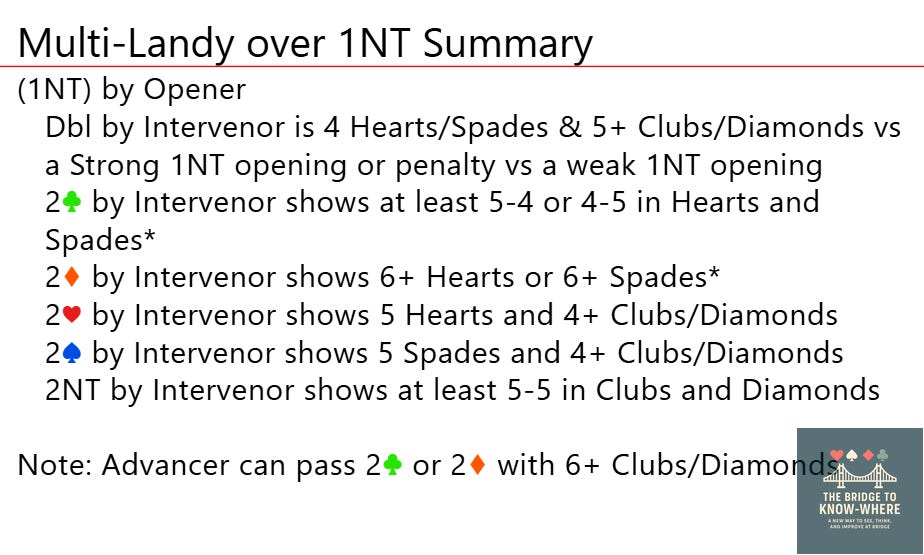
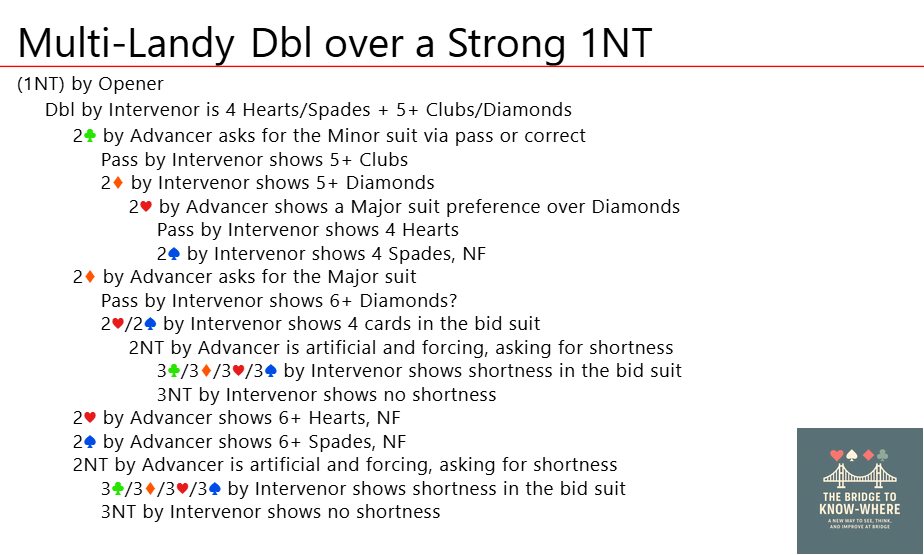
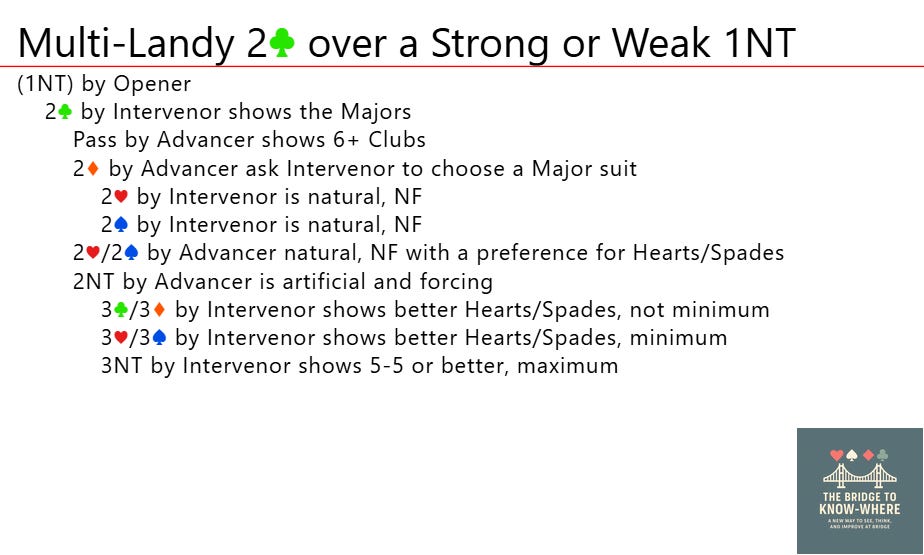
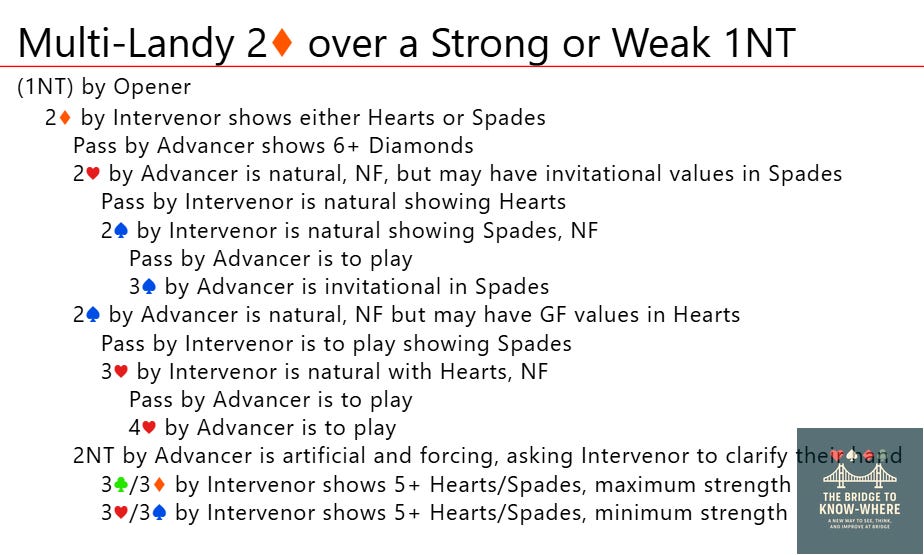
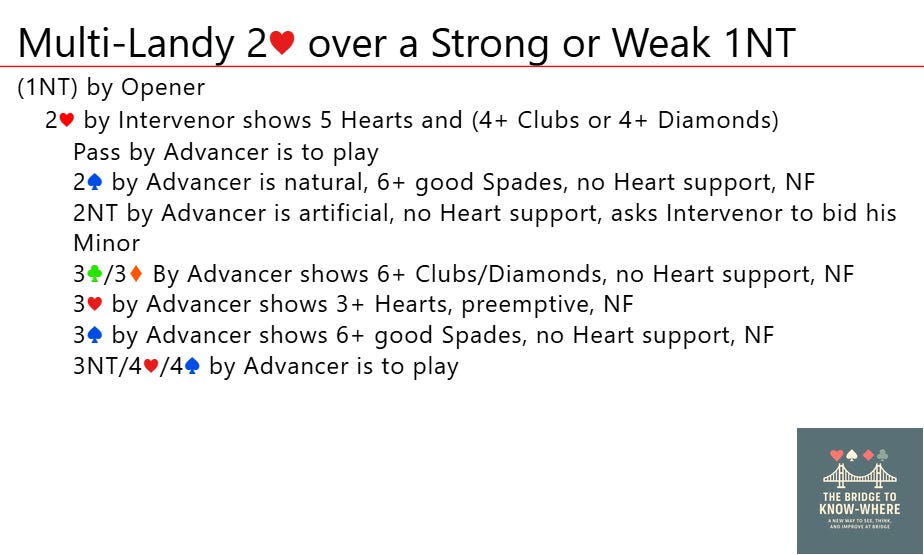
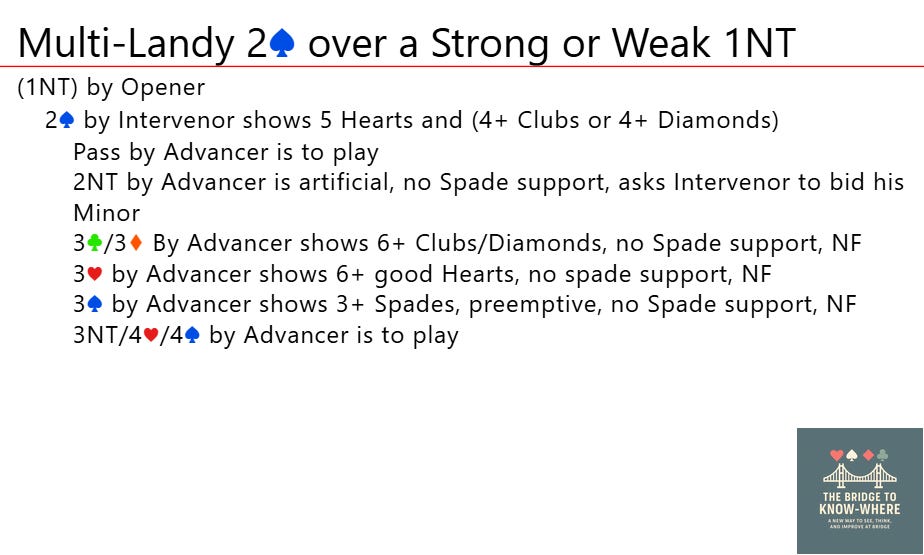
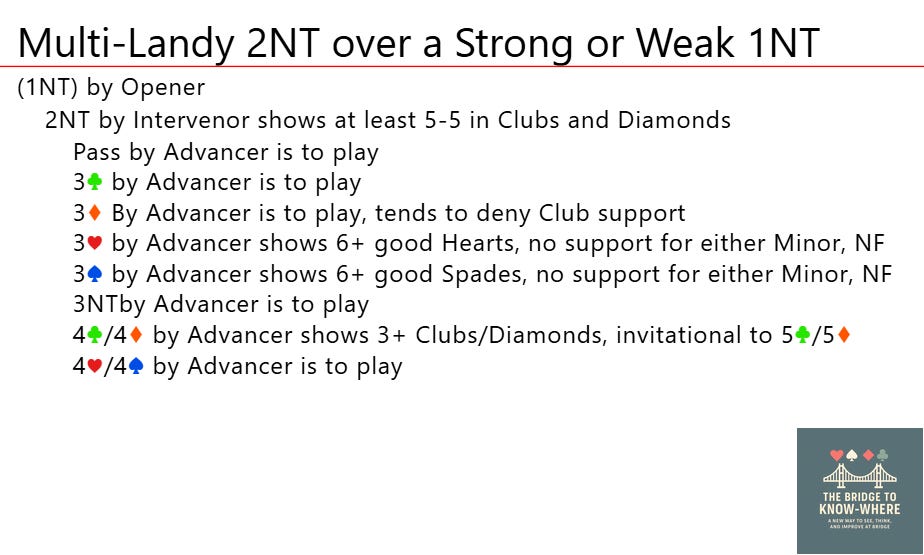
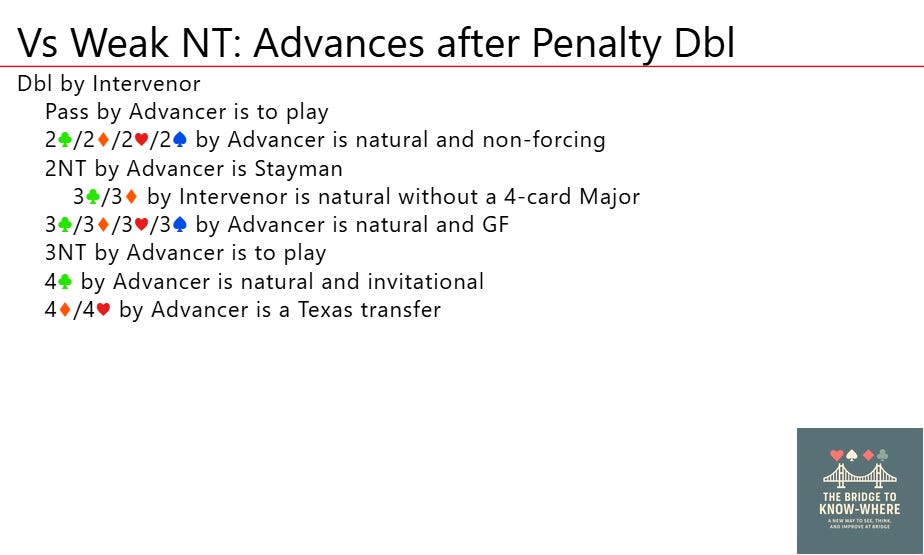
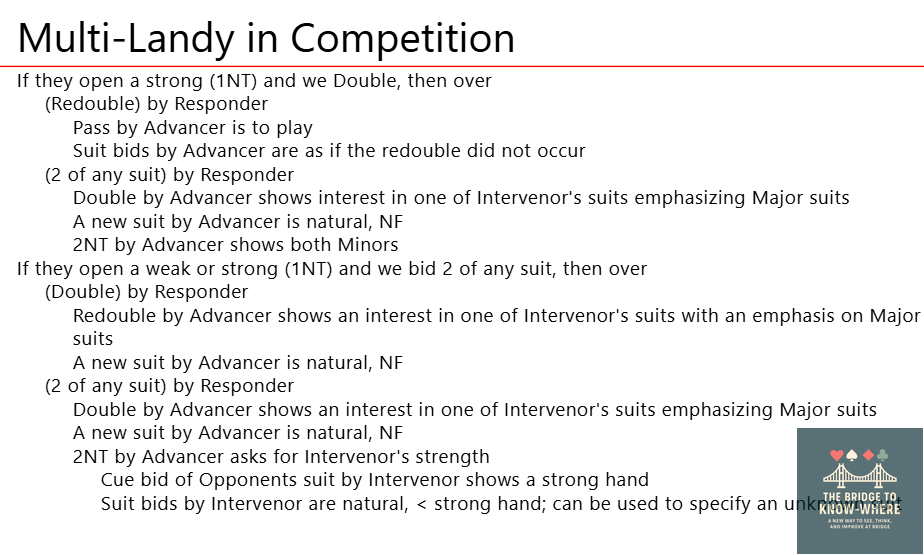
Mini-pack: Multi-Landy vs 1NT (strong and weak)
These nine cards expand the VS 1NT area on the ACBL convention card into clear, drillable agreements you can use if you play or want to play Multi-Landy over the opponents strong or weak 1NT opening.
This first screenshot shows what that section of the convention card might look like.
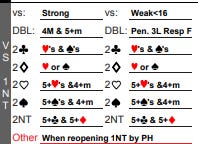
Images of the Multi-Landy flashcards appear below; the PDF download is right after the gallery.

How to use this mini-pack
Review the nine cards and make any agreed upon edits.
Mark anything that isn’t already automatic for either partner.
Practice only those items for a few minutes at a time (rereads, read-aloud, write-from-memory, 2–4 sample hands, quick Q→A).
Promote an item to automatic after it’s clean three times in a row (practice or play).
Why this hasn’t been done before
Because the convention card gets most pairs “good enough.”
• The card covers about 80% of what comes up.
• A quick round of verbal agreements can push you near 90%.
• In a 26-board session, opponents control or simplify roughly half the auctions, leaving maybe ~16 boards where your detailed agreements matter.
• If you slip on only 10% of those, that’s just 1–2 mishaps in a session—most pairs live with that.
Over volume, “good enough” is costly.
• Play a 10-day national at two sessions per day: roughly 20 sessions and ~512 hands.
• Even a 1% failure rate on understanding still yields around five avoidable mishaps that could be swings or bad boards.
Steps 2 and 3 exist to drive that error rate from “rare but painful” to “almost never.”
A note on traditional system notes
Many partnerships start with a document written by one partner, often in shorthand and sometimes incomplete. Treat notes as raw material, not the source of truth. Convert key items into flashcards you both read the same way.
Tell me what to release next
Was this Multi-Landy mini-pack useful? Use the comments to tell me which pack should be published next?
Minors
Majors
Notrump
Other
Something else
If you’re interested in getting standard or custom printed, laminated, hole-punched, ring-bound cards matched to your own convention card, let me know!
Bottom line
The convention card provides coverage. Flashcards document complete and accurate agreements. Red-Green is used to identify what isn’t automatic. Short, repeated practice with consistent-style flashcards turns shared understanding into reliable reflex—faster, better, and with less effort.